Trane AC Not Cooling in Arcadia
Answer in brief: When a Trane AC stops cooling in Arcadia, CA (91006) the usual causes are a failed dual-run capacitor, a refrigerant leak, a dirty Spine Fin coil, or a tripped contactor. Arcadia Trane HVAC clears most no-cool calls same-day, so call (213) 772-7221 or book online for Highland Oaks and Baldwin Stocker.
Key points
- Service area: Arcadia plus Highland Oaks, Baldwin Stocker, and Lower Rancho (91006, 91007, 91066).
- Top Arcadia no-cool cause: failed dual-run capacitor in sustained foothill heat.
- Low refrigerant always means a leak - we repair, not just top off.
- Ice on the line set points to low charge or restricted airflow - shut the unit off.
- Most no-cool calls are same-day; capacitor parts ride on the truck.
- Repair lane $150 to $1,500 typical; compressor failures higher.
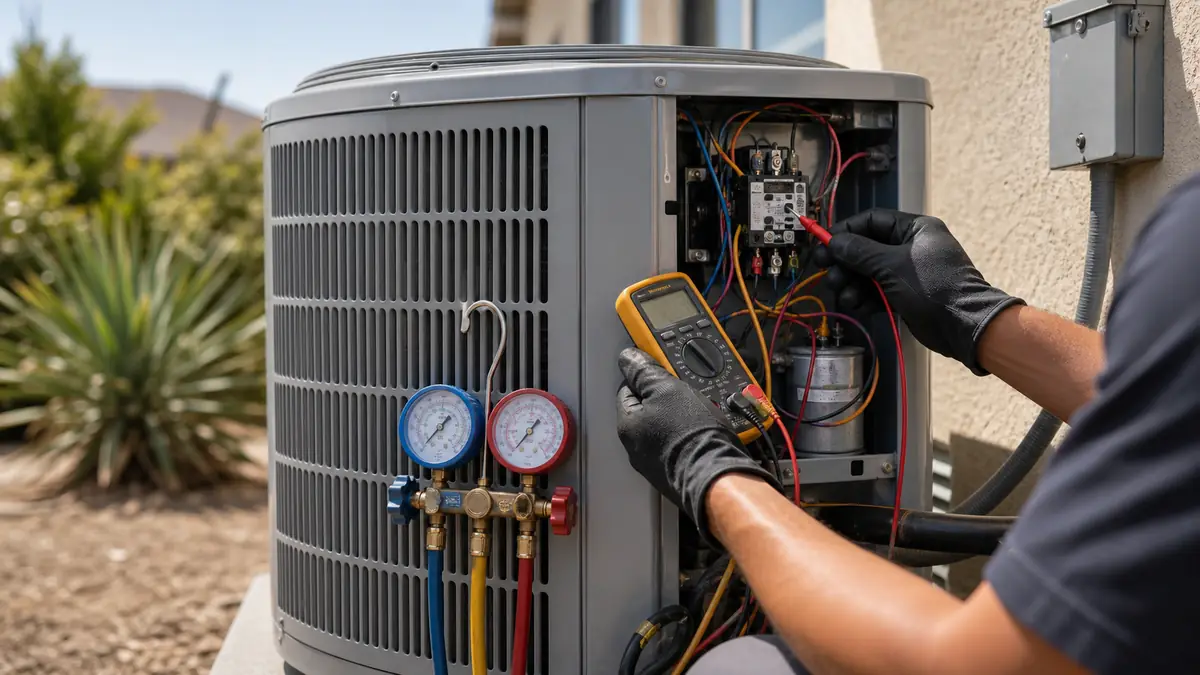
What stops a Trane from cooling in Arcadia heat?
Run through the likely causes in order. A humming outdoor unit whose fan or compressor will not start is almost always a dead dual-run capacitor - the number-one summer failure here. Warm air with ice on the line set is low refrigerant or airflow. A condenser that is silent and dead may have a tripped contactor or lost power. And a coil packed with Santa Ana dust simply cannot reject heat at 100 F.
| Symptom | Likely cause / first check | Cost lane |
|---|---|---|
| Outdoor fan hums, will not spin | Failed dual-run capacitor | $150 - $450 |
| Condenser silent, no power | Tripped contactor, breaker, or float switch | $150 - $450 |
| Warm air, ice on the line | Low refrigerant leak or airflow restriction | $225 - $1,500 |
| Runs constantly, weak cooling | Dirty Spine Fin coil or undersized return | $200 - $1,000 |
| No cool, compressor dead | Failed Climatuff compressor - weigh replacement | $1,200 - $3,500 |
Why is the capacitor the usual suspect here?
The dual-run capacitor is what hands the compressor and the fan motor the starting jolt they cannot start without. String together enough of Arcadia's 90-plus days, add a foothill position that bottles up the heat, and the dielectric inside that can cooks until it bulges and sheds capacitance - at which point the motor sits there humming, unable to turn over. The capacitor itself barely costs anything; the bill is mostly the truck roll and the labor. Rather than guess, we load-test it with a meter, swap it, and prove the unit is back by reading correct amp draw.
When is it the refrigerant or the compressor?
Because a low charge is never anything but a leak - the Spine Fin coil and the flare joints lead the list of where - we track it down and seal it before recharging to the correct subcool; a top-off is a band-aid that peels off in weeks. The real worst case is a dead compressor in an older XR13, which moves the talk toward replacement under the same age-and-cost math laid out in our repair-versus-replace guidance. If the unit also cycles oddly, see short cycling; for heat-side no-output, see no heat.
What can I safely check before calling?
A handful of safe checks can save you a service call. Start at the thermostat - it needs to be on cool and dialed below the current room temperature - then look at the breakers feeding the air handler and the condenser, since a foothill power blip trips them often. Swap out a gray, choked filter, because a starved coil freezes up and quits cooling. Give the outdoor unit its two feet of breathing room and clear away any Santa Ana leaf litter packed against it. That is the line: cracking the disconnect, metering a charged dual-run capacitor, or adding refrigerant crosses into hazardous, pro-only territory. A bulged capacitor can still hold a dangerous charge, and refrigerant handling is EPA-regulated work.
How does a tech diagnose a no-cool Trane in order?
The sequence is deliberate. First we confirm the call for cooling and 24V at the contactor, then watch whether the condenser fan and compressor start. A hum with no spin sends us straight to the dual-run capacitor, which we test under load with a meter against its rated microfarads. If it starts but cools weakly, we put gauges on and read superheat and subcool to separate a low-charge leak from a dirty Spine Fin coil or a restricted TXV. On a communicating XV20i we also read the XL850 or XL824 for a plain-language alert. Each reading rules a cause in or out, so you pay for one correct repair instead of a parts-swap guessing game.
Common questions
My Trane runs but blows warm air in Arcadia - what is wrong?
If the indoor fan blows but the air is warm, the outdoor unit usually is not cooling: a failed capacitor stopping the compressor, low refrigerant from a leak, a dirty Spine Fin coil, or a tripped contactor. Check whether the outdoor fan is spinning - if it hums but will not turn, that points straight at the capacitor.
Should I add refrigerant if my AC is low?
A sealed Trane system never consumes its refrigerant, so a low charge can only mean one thing in Arcadia: it is leaking out somewhere. Pour more in without finding that leak and you have bought a few weeks before the gauges read low again. We hunt down the leak - the Spine Fin coil and the flare joints are the usual culprits - seal it, then recharge to the correct subcool, because that is the only repair that actually holds.
Why does ice form on my AC line when it is 100 F outside?
Ice means the coil dropped below freezing, usually from low refrigerant or restricted airflow - a dirty filter, undersized return, or failing blower. Running it iced can slug the compressor with liquid. Shut it off, let it thaw, and have the airflow and charge checked before running again.
How fast can you fix a no-cool in Arcadia during a heat wave?
Most no-cool calls are same-day. The leading cause here is a failed dual-run capacitor, a part we carry on the truck, so a same-day visit often restores cooling within the appointment. Compressor or coil leaks take longer because of parts and recovery.